

Art for Your Summer Vacation, by John W. Healy
Kids can pack their shovel and pail, slather on the sunscreen and get ready to create their best artwork yet this summer
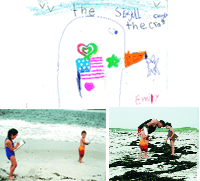
Emily's finished artwork came from her observations during a day at the beach with her brother and father.
Art can be the one activity that you can take to the beach, the lake and to special faraway places this summer. Being an artist on your vacation is an added dimension to how you see and experience the world you visit during this special time.
An exuberant search
Last summer, I spent an afternoon at the beach with my friend Dave, a technology teacher at my school, and his two children, Emily Rose, age six, and James, age four. Dave, a former bay man of Long Island, NY, is passing on his deep appreciation for the sea and its distinctive way of life to his children. With some rudimentary art supplies and Dave's off-road SUV, we all went, permit in hand, where seagulls, crabs and only the nautical of heart tread. Reaching a sparsely-visited location on the ocean's shore, the kids bounded from the vehicle with great self-assurance to a world they knew so well. Plastic pails in hand, they ran in a variety of directions, exploring, foraging and collecting treasures. This exuberant search was the first step in creating their art. The art produced as the result of this expedition recorded impressions of what they felt was most memorable. How carefully they took notice of this world so different from their own backyard!
Observing the unfamiliar
I gave each child a clipboard with colored paper attached, pencils, pens and crayons. What they would find valuable from this day at the shore would be anyone's guess. Observing that which is unfamiliar is a very strong stimulus in motivating children to learn. A variety of individual pictures was created by both Emily and James. Emily wanted to organize her renderings into a story book like the ones she had in her room at home. She did not see her collection of drawings as unrelated fragments but rather as a cohesive story to be organized and told. Her drawings, as she expressed to me, needed to be accompanied by a written narration and organized into book form.
A take-home assignment
This art activity is best represented as a take-home assignment with an accompanied hand-out to be shared with your students' parents. It should be reviewed in class prior to the end of the school year. Introduce this lesson by asking students, "Where will you be going during the summer vacation?" Some kids may not be going away. Include them by suggesting special places near your school that would be of interest to the entire class. Remind your class that art can be a great companion activity with which to share the summer.
In the past, recommended reading lists have provided children with valuable learning experiences that have helped to pass the time during the summer break. Art activities can also contribute to a summer filled with productive learning experiences. All of the following recommended art materials to facilitate this activity are inexpensive and will produce a minimum amount of clean up. Here are a few pointers for parents:
Clipboards.
These office supply staples (large enough to hold 8-1/2" x 11" paper) are quite useful. They are easily stored in luggage and provide the summer artist with a reliable platform for good-size drawings. The paper used can be a variety of colors, and watercolor brushes and watercolor paper can extend the capabilities of your students.
Waterproof plastic box.
One of these multipurpose boxes filled with pencils, colored pencils, crayons, scissors and other art supplies is a great accessory for a child to use for recording their summer experiences. It would also be good to include a basic starter set of watercolor paints, brushes and watercolor paper.
A gathering pail.
Any type of pail will be most helpful in collecting objects that kids can use to create artwork. Some of what is gathered in the pail may represent a variety of life forms from the natural world. All of what the child collects is useful. A child's newly-acquired field-observation skills will be helpful in science classes. Nature is truly an abundant source of metaphors that can be used in literature and writing classes.
Summer adventures
As the summer passes, your students' drawings will start to accumulate. Parents can organize the drawings in chronological order and make sure that the child adds a title page. On each page, the kids can add a description of his or her picture from their summer adventures. At the beginning of the school year, your students can hand these booklets of drawings in to your school's art teacher for extra credit or for class discussion.
Enjoy your summer!
Dr. John W. Healy teaches art at Woodland Middle School, East Meadow, NY.


Search Free Activities:
