

A Circus of Characters, by Maryann Manning
Activities with Clifford, Pooh, Olivia, Horton and other furry or feathered friends will get kids roaring with delight
"The weasel explained that he was sorry, but he was going to have to eat the shrew; he was the predator and the shrew was his prey. The mouse and his child stood and watched the animals as they waited for their keys to be wound so they could move on." (The Mouse and His Child, by Russell Hoban ©2001. Reprinted with permission, Scholastic, Inc.)
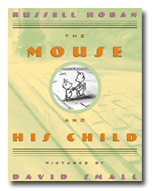
The Mouse and His Child by Russell Hoban (Scholastic, 2001).
This scene from The Mouse and His Child was reenacted by students after their teacher had read Russell Hoban's book, just reissued with wonderful illustrations by David Small.
Celebrating animal and other non-human book characters is pure joy for our students and for us because there are so many delightful characters who have brought us pleasure.
Characters are gifts
We each have our own personal list of favorite book characters, but a few of those who continue to bring me joy are Gloria, Angelina, Olivia, Horton, Pooh, Clifford, Sounder, Stuart Little, Charlotte, Wilbur, Sylvester, Stellaluna, Pinocchio, Paddington, the Velveteen Rabbit, Corduroy and Curious George. All of these characters are the gifts of illustrators and authors such as Peggy Rathman, Ian Falconer, E.B. White and Dr. Seuss.
We often think of animal characters as only appealing to younger children because many are in picture books. However, middle school students read and reread Old Yeller and Sounder and clamor to discover the fate of Nipper in Jerry Spinelli's Wringer (HarperCollins, 1998).
Revisiting Charlotte
A sixth grade teacher recently told me that her students asked her to read Charlotte's Web (HarperCollins, 1974) aloud because they wanted to relive the experience of having heard the book read aloud in lower grades.
The study of animal characters in books bears many similarities to the study of human characters. One special benefit of a shared study is the building of classroom community when, for example, everyone in the class (including the teacher) fears for Wilbur's life. A lot of emotional energy is shared when everyone holds his or her breath, hoping Charlotte will save him.
Well-written plots have strong, lifelike characters who develop throughout the story. There are many opportunities to study the ways in which animals are like humans, become heroic figures in a realistic way, and possess good and evil qualities, as well as magical powers.
Expanding imaginations
Discussion possibilities about these characters are abundant. All the famous mice, bears and roosters can be compared with the animals by different illustrators such as Jan Brett, Beatrix Potter, Janet Stevens and David McPhail. Graphic organizers such as relationship charts and webs help our students see the differences and similarities such as looking at character traits (grumpy, arrogant, etc.). Imaginations expand when brainstorming ideas for sequels to books so the animals or other characters can grow up or have more adventures.
There are so many different ways to celebrate animal book characters but here are some that may remind you of ideas you have used. Many of those discussed can be adapted for older students.
Endless writing possibilities
Writing extensions range from writing about which animal book character you would like to be to researching the life of the animal and then comparing factual information with the character's life.
Many picture books have obvious writing extensions such as developing a lost bear announcement for Corduroy. "What if" stories can be written about such things as "What if Goldilocks had met up with goats? How would the book have been different?" Writing parallel books is effective with young children and older children.
The Very Quiet Cricket by Eric Carle (Penguin Putnam, 1998).
Like writing and speaking, drama, art and music are all processes through which students express their knowledge. Drama activities include role-playing a veterinarian or life in a pet shop for animal characters. Students enjoy creating a character circus and putting the animals on parade uttering favorite lines. One class combined drama and music when they wrote and performed a piece called "Entomologist's Symphony," following the reading of The Very Quiet Cricket and other wonderful insect books by Eric Carle.
All of the usual art forms from dioramas to mobiles and more can be used with animal characters. Creating a still-life zoo with drawings or a mural of animal characters can be attractive; adding speech bubbles for dialogue creates additional interest.
Lunch with the animals
One of my favorite celebrations for primary students is an animal character tea party or luncheon with each student dressing as a favorite character. The menu can be a version of some of the animals' foods, which is easier if they are vegetarians (alfalfa sprouts, carrots and other vegetables). The party can be about only one character such as a Hungry Caterpillar luncheon when the menu is dictated by adaptations from the text. I attended a Hungry Caterpillar luncheon where the children served decorated Jell-O™ squares for the different foods.
I could go on indefinitely reminding you of ways to celebrate the wonderful animal book characters that you and your students love. Like you, I enjoy so many but my favorite is a character that many of you are too young to remember, Roger Duvoisin's character, Petunia. I will be laughing in the rest home about her silly pride. I am hoping that you'll be able to find an out-of-print copy so you can laugh with me.
Life's literacy Lessons
by Steven L. Layne
First Grade
Squiggles.
Indecipherable, incomprehensible;
Foreign yet familiar.
Cherub faces eyeing pages
Filled to bursting with squiggles –
A banquet set for voracious appetites.
Prepare the meal with the utmost care.
Serve it on the fine china.
Don't forget the dessert.
Learning how to read shouldn't hurt.
Layne, Steven L. (2001). Life's Literacy Lessons: Poems for Teachers. Newark, DE: International Reading Association. Reprinted with permission of the International Reading Association
Maryann Manning is on the faculty of the School of Education, the University of Alabama at Birmingham.


Search Free Activities:
