

Getting to the Heart of a Story, by Karen E. Mitchell
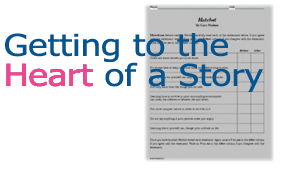
A teacher shares how the time-tested tool of Anticipation Guides helped her students comprehend themes
While listening in on a small-group discussion of Hatchet by Gary Paulsen (Atheneum, 1987), I was dismayed to hear my fourth-grade students agree that the story was about nothing more than a "kid who crashes in the wilderness." Was that all they took from this multifaceted tale? Surely, living in our Colorado community that had been impacted by the largest forest fire in state history, the 2002 Hayman fire, they would have more to say about survival in the wilderness. What did their comments reveal about their level of comprehension?
Merging knowledge.
While many teachers teach comprehension strategies by concentrating on isolated skills, often in the form of worksheet drills, comprehension is actually an active, constructive process that occurs before, during and after reading a particular selection. In order to comprehend reading material, readers must merge the knowledge they already own, often referred to as prior knowledge, with the information they are reading.
Students who are able to activate their prior knowledge of the concepts about which they are reading remember more than do students with little or no prior knowledge. As teachers, then, we must help our students – particularly, struggling readers – trigger their prior knowledge before reading so that they can concentrate their reading effort towards merging their knowledge with the new information and ideas they encounter.
When students link new information to prior knowledge, their interest and curiosity are motivated. Readers are motivated to continue reading a selection if they are searching for answers to questions they've formulated in their minds. While identifying noteworthy information in nonfiction texts is relatively easy for most students, particularly if the text is well-structured, students often have difficulty identifying the themes in fictional selections. Yet, the theme is the heart of a story. How can we help our students activate prior knowledge, set a purpose for reading and identify a story's themes? I use an Anticipation Guide.
Predict and connect.
Developed in 1986 by J.E. Readence, the Anticipation Guide relies on prediction to make connections that lead to comprehension. This organizer guides students to reflect on carefully constructed statements that will help them link their prior knowledge and preconceived ideas to the information they will read. In addition to setting a purpose for reading, the Anticipation Guide also promotes interest and encourages higher-level thinking. A very versatile tool, I use the Anticipation Guide before, during and after reading.
Make it personal.
I find an Anticipation Guide is most effective in areas where students have some preconceived notions relating to the concepts and themes presented. Students, particularly in older grades, have thoughts and ideas about most themes they will encounter in literature. The statements in the Anticipation Guide are created to support and contrast an author's ideas with students' belief systems. While students may disagree with how a protagonist feels about or reacts to a theme in a story, they are still thinking about and reacting to the theme on a personal level, leading to greater comprehension.
Some themes, such as terrorism and homelessness, are naturally more complex than others, yet students can still respond to these themes. Although readers expect the protagonist's problem to reach some kind of resolution, they understand that a theme or issue bigger than the character's immediate problem may not have resolution. The Anticipation Guide serves to connect a student to the reading selection, not to force students to resolve all the uncertainty they may experience when considering the theme.
The difference a guide makes.
In developing an Anticipation Guide for Hatchet, I chose eight statements to guide students to examine some prominent themes from the story, including keeping family secrets, surviving in nature and personal growth. After using this Anticipation Guide the next school year, I was thrilled to overhear a student say the following: "I think that the story is about learning to adapt to your environment, not just the outdoors, but the people you live with, too. If you expect them to change for you, you are going to get really frustrated." I think he got it!
Before presenting a fictional selection to students, identify the major themes (or the important information in a nonfiction selection). Then follow these steps:
Write 3-10 statements that will cause students to evaluate their beliefs and challenge them to analyze those beliefs. (For younger students, write simple statements on chart paper and discuss them as a whole group.)
Create columns in which students may record their personal responses to each statement. Students can respond to statements with yes-no, true-false, agree-disagree or likely-unlikely options. You may want to include gradations for themes that are particularly complex or for which students may respond differently depending upon the circumstance or situation.
Before reading the selection, have students react to the statements by checking the appropriate column. It often helps, particularly with younger students, to read each statement aloud prior to responding in order to clarify any misconceptions or ambiguities.
Allow students time to read the selection to confirm or discredit their responses. As a variation, you can also have your students record how they believe major characters feel about the statements in the Anticipation Guide.
Give students opportunities to discuss or respond to their beliefs about the theme(s) as it relates to the story being read. You may want to stage debates, conduct small-group discussions or create individual projects to help students respond to the theme(s). The Anticipation Guide can serve as a starting point for follow-up activities
.

Topic: Hatchet Book Study
Focusing activity to begin novel: Hatchet by Paulsen. Students will visualize how Brian Robeson felt when he crash lands on the deserted island at the beginning of the novel, Hatchet. This whole class period will be spent using prior knowledge of survival skills.
Hatchet: A well-organized resource divided by book chapter. Each chapter category has online (and printable) questions for your book study, activities that tie into the chapter themes, writing lessons and vocabulary activities.
To download Karen E. Mitchell's sample Anticipation Guide for Hatchet click here (PDF 12KB)
Karen E. Mitchell is an elementary school teacher who holds a Master's degree in Curriculum and Development. She lives in Woodland Park, CO.


Search Free Activities:
