

A Light in the Night, by John W. Healy
The firefly is illuminating both as an art subject and as a metaphor for a feeling all students have at one time or another – loneliness
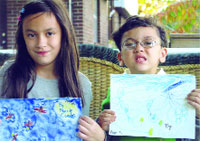
Luminous art – Nicole Castro, 8, and Daniel Castro, 5, display their different renditions of fireflies in the night sky.
Have you ever, as a child or an adult, chased a firefly at night? Perhaps you did this past summer. You followed with boundless energy and great haste after the flickering light. The shimmering glow of these darting insects is contrasted by the infinity of the darkness they traverse. You may run to complete exhaustion, giving the pursuit everything you have, yet not feel drained. A bug in your garden is far less appealing during daylight hours! As a subject, the firefly can be used to create contrast that illuminates a special moment worthy of being captured in an expressive work of art.
The lonely firefly
Fireflies have been used as a metaphor for an important aspect of the human condition, loneliness, most memorably in The Very Lonely Firefly by Eric Carle (Philomel, 1995). In this book, the author uses a common firefly for an insightful look into belonging. His firefly starts its life's journey at night, alone, searching for companionship. While sending out beacons of intermittent light, the firefly searches for others to become whole. It encounters a variety of lights that it initially mistakes for other fireflies – a lightbulb, a candle, a flashlight, a lantern, the bright night eyes of a dog, cat and owl, car headlights and fireworks. The final pages are covered with many fireflies, and the firefly is lonely no more.
Some other books by Eric Carle that pair beautiful artwork with important developmental themes are The Very Hungry Caterpillar (Philomel, 1981) (Hope), The Very Busy Spider (Philomel, 1985) (Work) and The Very Quiet Cricket (Philomel, 1990) (Love). These books simplify difficult concepts for children to understand along with artwork that is youthful and exuberant.
Reaching out through art
Combined with contrast in art, the lesson of the firefly can bring art instruction to a higher level. We have so many students in our classes for whom loneliness may be an issue. Is there ever a school year when we don't meet students who, for any of a wide variety of reasons, are not "in the mix" of the activities we spend so much time planning?
We encounter loneliness by not feeling a part of the world in which we live. Loneliness is a place, however, that gives us a vantage point from which to reflect. The loss of a parent, family member, friend and certainly leaving one's school and community contributes to the void of loneliness. Contrast can be a key variable in the creation of a work of art, and art can be the courier of meaningful messages that are shared with others. Why feel alone?
Discussing art can be appealing and engaging to others who are drawn into the shared meaning of what has been created. When students are encouraged to speak proudly about the art they create and answer questions from their peers about what they have accomplished, a wider world of relationships can be realized. Respect and peer interest can come through accomplishments that are noticed.
A firefly art project
Show the class The Very Lonely Firefly. Turn the pages, telling the brief story and speaking descriptively about the engaging illustrations. Describe how the artwork compliments the storyline. The concept of contrast can be defined and introduced as it relates to these pictures.
Ask your students if they have ever chased a firefly at night. If students haven't had this experience, ask them to imagine what it might be like.
Have the students create a picture that depicts the experience of chasing fireflies at night.
Demonstrate to the class some of the possibilities inherent in the use of the following art materials (white or colored paper will work for this project):
Colored pencils – may be used for detail in the illustration as well as subtle variation of color
Blow pens – function like an airbrush that evenly sprays a spattering of water-based paint onto the working surface
Glitter clay – provides a three-dimensional aspect to the artwork as well as luminosity
Glitter pens – Capture the iridescence of reflected light
Keep in mind a student you'd like to help enter the class' mainstream. When that child has success with an art project that is in progress or recently completed, quietly ask him or her if you may show the project to the rest of the class. Be careful not to push this request. If he or she is willing to participate, hold up the project to the class while the other students are still working on this assignment. Identify how the piece meets the assignment requirements, and point out a particular aspect that makes it special. Ask the student how he or she created something so successful. This will reinforce the class project as the class is still working, as well as bring the student recognition.
Dr. John W. Healy teaches art at Woodland Middle School, East Meadow, NY.


Search Free Activities:
